Personalize
Right lesson. Right moment.
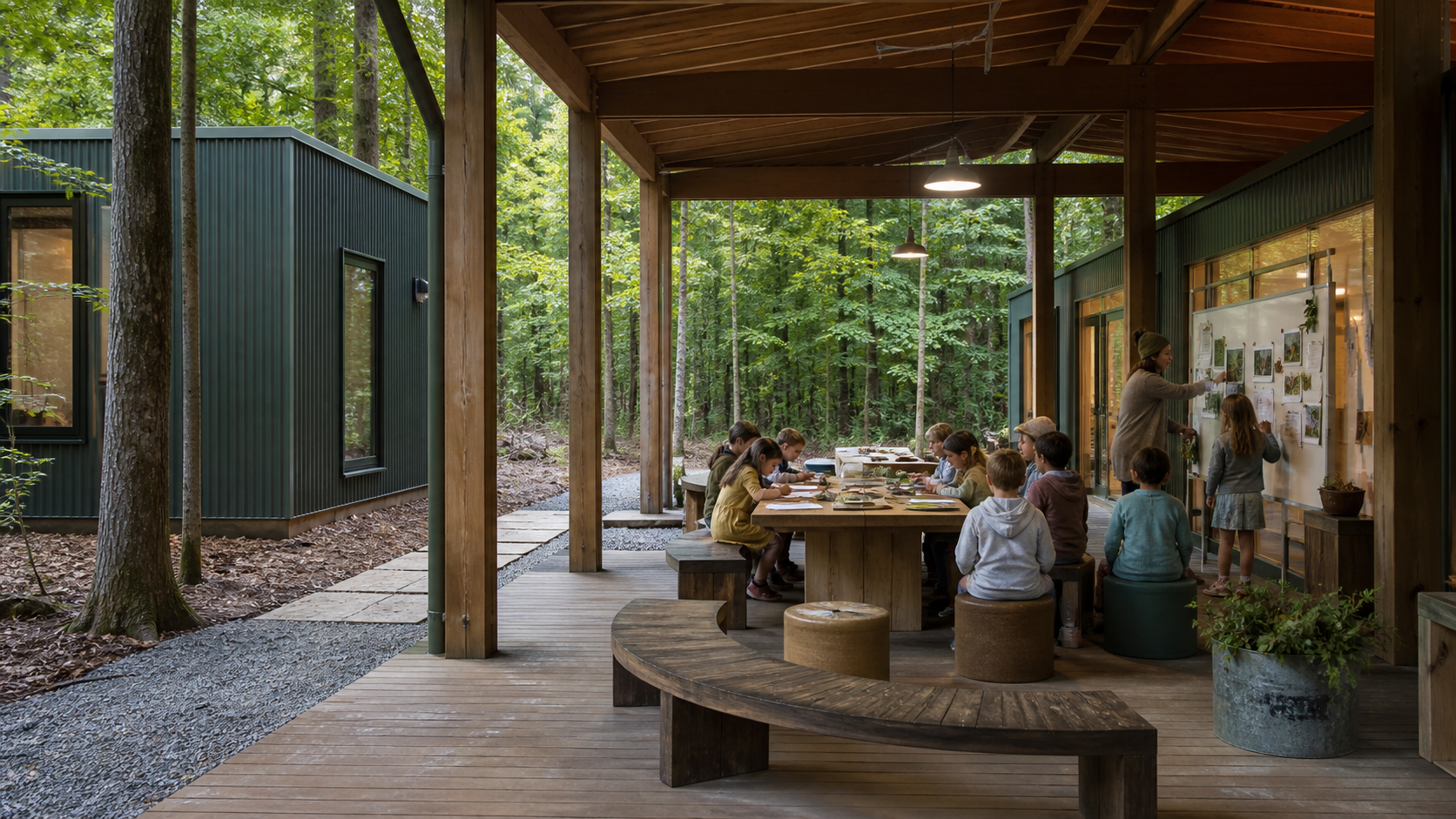
Milwaukee · Proposed public charter · 2027
A modern village where personalized academics create more room for play, nature, meaningful work, and the relationships children need.
The false choice
Families should not have to choose.
Understory is designed for both.
The operating model
Technology works quietly in the background—recovering time and money for what only people can do.
Right lesson. Right moment.
Fewer administrative layers.
Play. Nature. Meaningful work.
Evidence-backed growth.
More childhood. More evidence. Lower overhead.
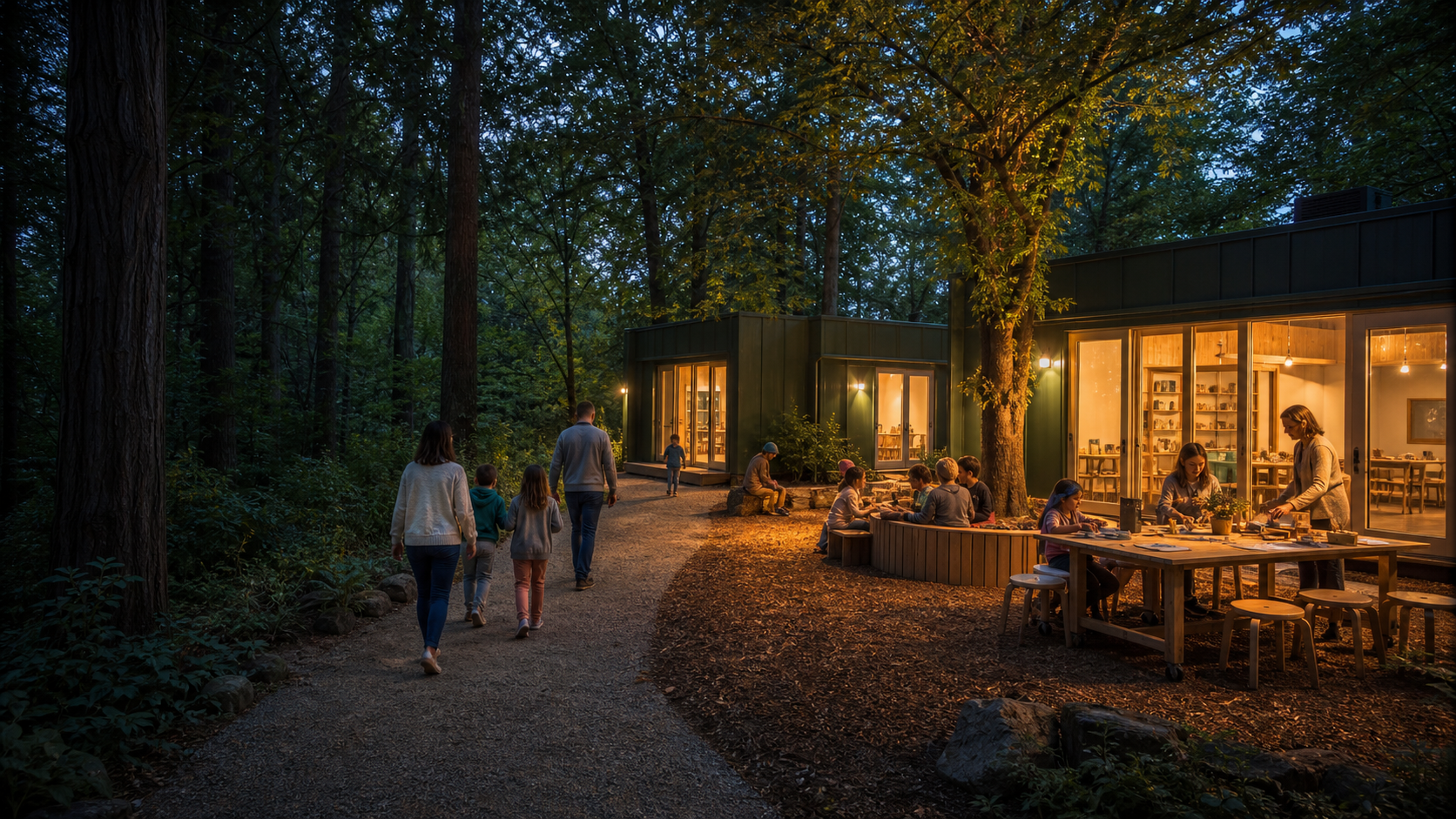 Concept visualization
Why this is different
This is not a technology-first school. It is a childhood-first school made possible by better tools.
Fewer layers and shared services direct resources toward educators, experiences, and learning.
Nature, movement, risk, food, friendship, and independence are part of the school day—not rewards after it.
One consistent 1–100 language combines benchmarks, observations, portfolios, and reflection.
A day at The Understory
Five rhythms. One whole child.
The Understory Growth Map
Grades answer, “Did they complete the work?” Families deserve to know, “How is my child growing—and what comes next?”
01 One 1–100 language across the whole child
02 Every score tied to visible evidence
03 Every update ends with a next step
Illustrative sample · not student data
Three growth highlights
How a child understands, reasons, and learns.
How a child builds physical confidence and healthy daily rhythms.
How a child understands, manages, and directs themselves.
How a child builds trust and contributes with other people.
How a child understands their place and acts with responsibility.
How a child imagines, makes, experiments, and improves original work.
Use field observations to propose one realistic improvement for a shared community place.
What the six dimensions mean
These are six parts of one child—not six separate grades. Each score summarizes demonstrated growth against age- and grade-specific rubric anchors.
How a child understands, reasons, and learns.
Subskills behind the score
What educators look for
Literacy · numeracy · problem solving · attention · planning · learning strategies
What we observed
Explains ideas from text, shows the steps in mathematical reasoning, and independently revises after feedback.
Evidence reviewed
2 benchmarks · 4 work samples · 6 observations · 1 project rubric
May include: Reading and math benchmarks · writing and work samples · project rubrics · teacher observation.Support conclusions with two specific pieces of evidence.
Ask: “What evidence helped you reach that conclusion?”
Student voice“I’m proud that I kept trying different ways until it made sense.”
How a child builds physical confidence and healthy daily rhythms.
Subskills behind the score
What educators look for
Movement · coordination · stamina · outdoor engagement · safe risk · healthy routines
What we observed
Sustains active play for longer periods, navigates uneven terrain safely, and notices when the body needs rest or water.
Evidence reviewed
5 movement observations · 2 skill demonstrations · 4 reflections
May include: Movement observation · skill demonstrations · participation patterns · student goal reflections.Build balance and pacing during longer, multi-step outdoor challenges.
Invite Maya to plan the route and rest stops for a family walk.
Student voice“I climbed farther because I stopped, looked, and tried again.”
How a child understands, manages, and directs themselves.
Subskills behind the score
What educators look for
Self-awareness · regulation · persistence · independence · initiative · follow-through
What we observed
Names frustration, selects a calming strategy, and returns to challenging work with less adult prompting.
Evidence reviewed
8 observations · 3 goal check-ins · 4 student reflections
May include: Teacher rubrics · student reflection · goal completion · learning and behavior notes.Choose and track one independent goal across an entire week.
Ask Maya to name the strategy she wants to use before a difficult task.
Student voice“Taking a breath helps me get my brain ready again.”
How a child builds trust and contributes with other people.
Subskills behind the score
What educators look for
Empathy · communication · collaboration · inclusion · leadership · conflict repair
What we observed
Invites quieter peers into group work, listens to competing ideas, and helps the group reach a shared decision.
Evidence reviewed
6 collaboration rubrics · 3 peer responses · 5 observations
May include: Collaboration rubrics · peer feedback · teacher observation · community-circle reflection.Practice naming the problem and proposing a repair after conflict.
Use: “What happened, who was affected, and what could repair it?”
Student voice“Our idea got better when everybody added something.”
How a child understands their place and acts with responsibility.
Subskills behind the score
What educators look for
Curiosity · stewardship · real-world application · community knowledge · contribution
What we observed
Asks strong questions during fieldwork and records careful observations, but still needs support connecting findings to community action.
Evidence reviewed
2 project artifacts · 3 fieldwork notes · 1 presentation · 1 partner response
May include: Project artifacts · fieldwork notes · exhibitions · presentations · partner feedback.Use field observations to propose one realistic improvement for a shared place.
Notice one neighborhood problem together and brainstorm three possible responses.
Student voice“I want to make a sign so people know why the creek matters.”
How a child imagines, makes, experiments, and improves original work.
Subskills behind the score
What educators look for
Idea generation · expression · experimentation · design · revision · productive risk-taking
What we observed
Generates several original approaches, tests materials confidently, and increasingly uses feedback to improve a design.
Evidence reviewed
5 portfolio pieces · 2 process reviews · 1 exhibition · 3 reflections
May include: Creative portfolio · design-process artifacts · performance or exhibition · student reflection.Document why each revision made the final work stronger.
Ask: “What changed between your first idea and your final one?”
Student voice“The part that failed showed me what to build next.”
How the 1–100 scale works
A 77 is not 77% correct, a letter grade, an IQ score, or a percentile ranking. It describes the level a child consistently demonstrates on a defined developmental rubric.
The skill is beginning to appear with substantial support.
The child demonstrates parts of the skill with regular support.
The skill is becoming more consistent in familiar situations.
The child uses the skill independently in multiple situations.
The child transfers, adapts, and deepens the skill in new situations.
Benchmarks, observations, portfolios, projects, and reflection create multiple evidence points.
Educators compare evidence to shared age- and grade-specific rubric anchors for consistency.
Families see the current score, change from baseline, supporting evidence, and plain-language meaning.
Every reporting cycle ends with a focused next step for the child, educator, and family.
Planned measurement framework for the 2027 pilot. Rubrics, evidence rules, and calibration protocols will be tested and refined before reporting live student results.
The focused launch
One Milwaukee pilot. Evidence before expansion.
Launch gate: confirm demand for all 75 seats before major fixed commitments.
Founding team
Community access meets deliberate school design.
Partnerships + launch
Community · authorization · capital · enrollment
Learning + school design
Learning model · educators · experience · measurement
The 2027 invitation
We’re gathering the founding community of Milwaukee families, educators, partners, and supporters who want to help make this real.